Issue search
The issue search can be used to search for issues. The issue search can be opened from the sidebar.
Closed issues, that are no longer displayed in the additional tab "Issues", can still be found using the issue search.
Issue search
To search for issues, a search term can be entered in the search field.

The issue search is implemented as a full-text search and searches the following issue properties:
- Title
- Description
- Ticket number
The searched text is divided by separators (e.g. spaces, hyphens, and slashes). Only matches from the beginning of a word (i.e. after a separator) are found. Text within a word is not found.
The search results are displayed directly in the preview.
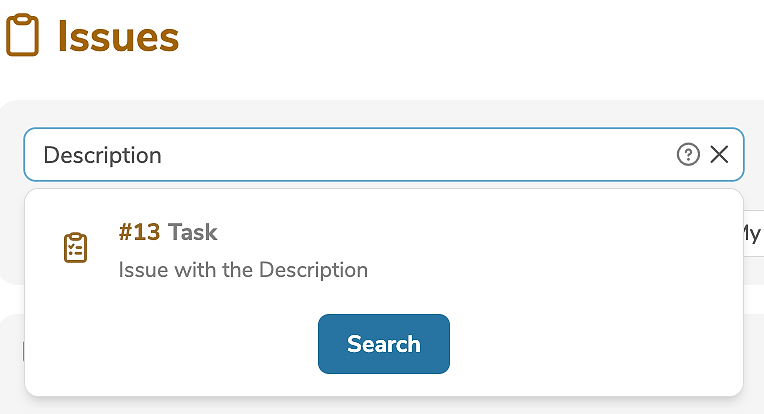
By clicking on the preview a found issue can be opened. By clicking on "Search" all issues found are displayed and can be browsed.
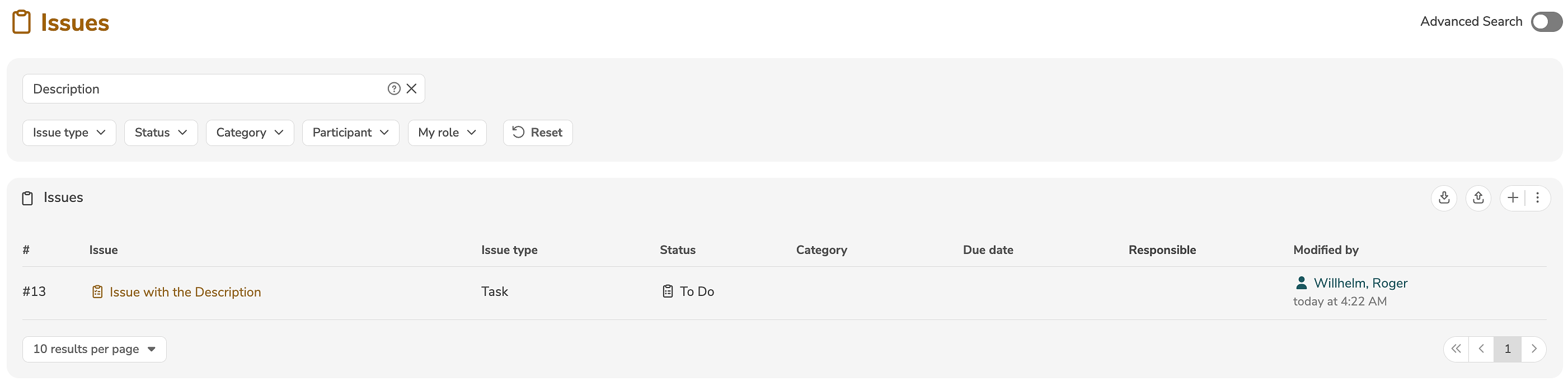
If no search term was entered in the search field, the following filters are applied without a full-text search (i.e. to all issues).
Filters
The search results can be filtered according to further criteria:
| Filter | Description |
|---|---|
| Issue type | Only display issues with specific issue types. |
| Status | Only display issues with specific statuses. |
| Category | Only display issues with specific categories. |
| My role | Only display issues where the user is assigned in a specific role. |
The customer-specific categories can be configured in the annotations.
The selected filters are displayed as tiles below the dropdown lists:

By clicking on the icon  , the search results can be exported.
Advanced issue search
The advanced issue search can be turned on and off by clicking on the following button:

The advanced issue search allows multiple search conditions to be defined. For example, to display all issues for which
Titlecontains the valueCustomer,- and
Statusis eitherRejectedorDone:

In contrast to the normal issue search, in which only a few selected filters are available, arbitrary search conditions can be defined in the advanced issue search. When the advanced issue search is activated, the previously selected filters are automatically applied as search conditions in the advanced issue search.
- Clicking on "+" adds a new search condition.
- Clicking on "-" deletes a search condition.
- Clicking on "Reset" deletes all search conditions.
- Clicking on "Search" displays the found issues.
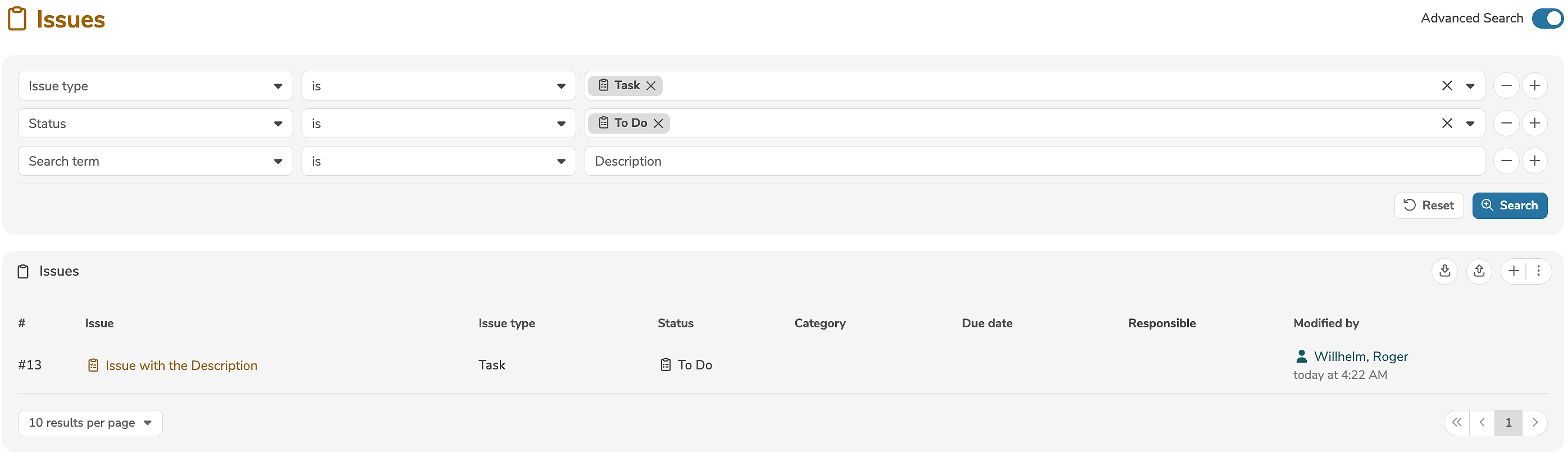
The search result only contains issues that satisfy all search conditions, i.e. the search conditions are logically conjuncted with AND.
Each search condition evaluates a property of an issue. The property can be selected in the first dropdown list. A customer-specific property can be specified by selecting "More properties..." in the first dropdown list and the customer-specific property in the second dropdown list.

The search operator and the value (or pattern), with which the property is to be evaluated, must be specified. Depending on the property, different search operators are available:
| Search operator | Description |
|---|---|
| is | Evaluates if the property is equal to the value. |
| is not | Evaluates if the property is not equal to the value. |
| contains | Evaluates if the property contains the value. |
| starts with | Evaluates if the property starts with the value. |
| ends with | Evaluates if the property ends with the value. |
| like | Evaluates if the property matches the pattern. |
| greater than | Evaluates if the property is greater than the value. |
| less than | Evaluates if the property is less than the value. |
The search operator "like" uses a pattern to evaluate the property.
A % in the pattern matches any number of characters.
A _ in the pattern matches exactly one character.
The values of properties, that are based on a list of valid values (e.g. literals), are displayed in a dropdown list.
In this case, several values can typically be selected:

The following special properties are also available:
| Property | Value range | Description |
|---|---|---|
| Search term | Text | Corresponds to the search field (full-text search) of the normal issue search. |
| Status | Statuses | Evaluates specific statuses. |
| Closed | Yes/No | Evaluates if the issue is closed. |
| Ticket number | Number | Evaluates the ticket number. |
| Severity | Severities | Evaluates specific severities. |
| Priority | Priorities | Evaluates specific priorities. |
| Category | custom list of categories | Evaluates the list of categories. |
| Issue type | Issues types | Evaluates specific issue types. |
| Title | Text | Evaluates the title. |
| Due date | Date | Evaluates the date on which the issue is due. |
| Date of change | Date | Evaluates the date on which the issue was last modified. |
| Modified by | Login ID | Evaluates the user who last modified the issue. |
| Created by | Login ID | Evaluates the user who created the issue. |
| Description | Text | Evaluates the description. |
| Id | UUID | Evaluates the UUID of the issue. |
By clicking on the icon , the search results can be exported.